The Goodwill Theatre Performing Arts Complex and Conference Center will consist of two historic Endicott-Johnson Shoe Company buildings connected by a newly constructed connector building and a central loading dock. The National Register-listed historic buildings in the complex include the Goodwill Theatre (36 Willow Street) and the Former Municipal Building Central Fire Station (48 Willow Street) which we now refer to as the Firehouse. These two legacy buildings will be fully rehabilitated and adapted for community use. Goodwill Theatre, Inc. also owns the former EJ Medical Building (67 Broad Street), where our administrative offices are currently housed. Unfortunately, this building will not be saved.
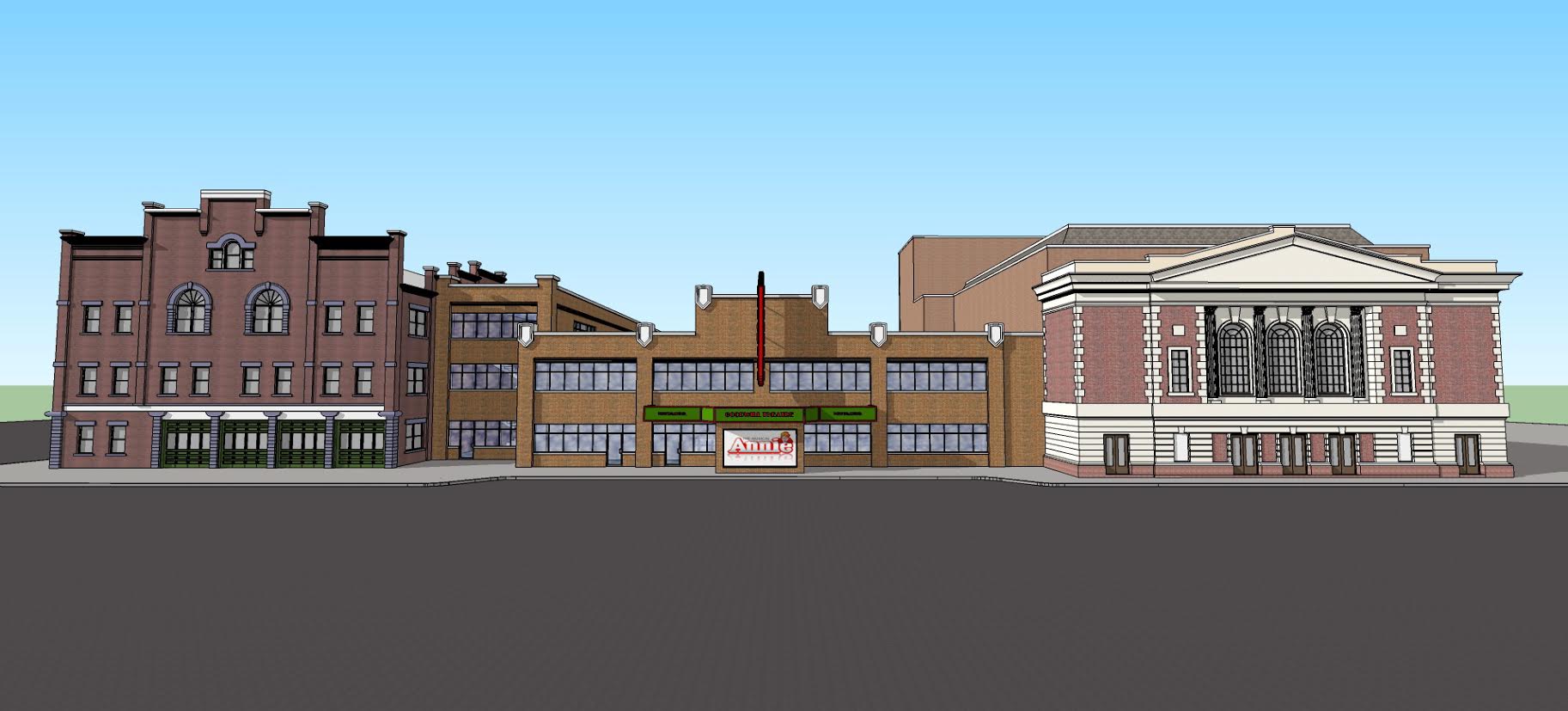
The complex will house three state-of-the-art performance stages of differing sizes and styles to increase entertainment options and enhance the versatility of performance styles, audience experiences, and student’s backstage skill sets. The Goodwill Theatre stage house expansion will contain a loading dock, dressing rooms, production facility with support/design spaces. A central lobby, patron restrooms, elevators, stair towers, rehearsal halls, concession options, offices, classrooms, and a 200-seat film screening room will be located in the Connector Building. In October of 2007, Goodwill Theatre opened the Schorr Family Firehouse Stage. The Schorr Family Firehouse Stage is the first venue to open. It is a 150-seat flexible cabaret-style venue. It opened in 2007 and hosts comedy, music, Theatre for Young Audiences, other touring professional touring shows, and rentals Visit www.firehousestage.org for more information..
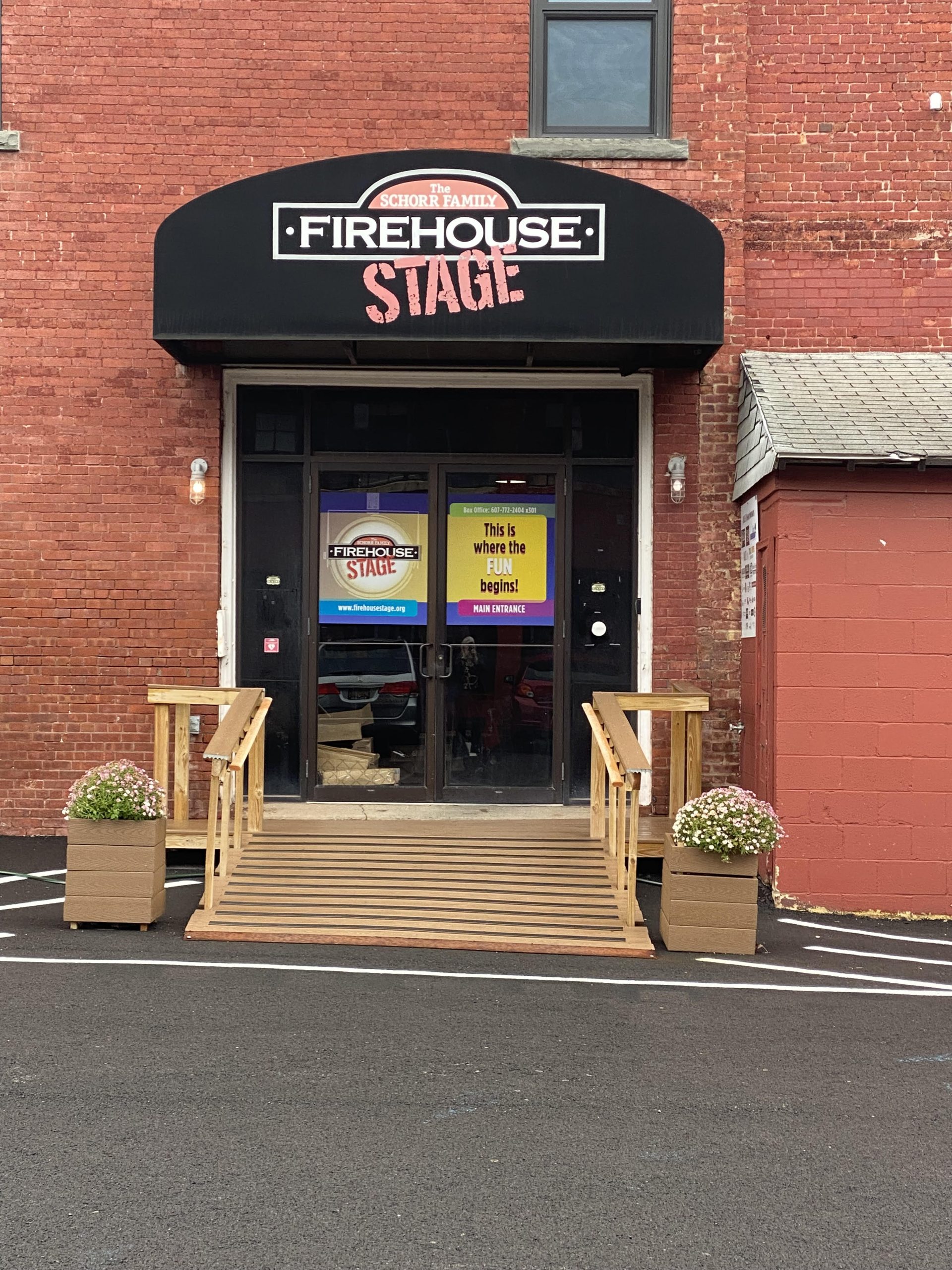
The SCHORR FAMILY FIREHOUSE STAGE, the first venue of the Goodwill Theatre Performing arts Complex and Professional Training Academy opened in October of 2007. This flexible and intimate venue allows Goodwill Theatre Inc. to present Theatre for Young Audiences, new plays, Story Time Theatre, puppetry, comedy, dance, classical music, cabaret, jazz, workshops, and family films. It also serves as a rental venue for local cultural organizations, private events, and local businesses.
Goodwill Theatre, Inc. will host a professional Actor’s Equity resident company that will perform popular shows, Theatre for Young Audiences (TYA), classics, and new work, The Complex will also present touring shows, dance, puppetry, comedy, chamber music, cabaret, music, film, visual and media artists as well as interdisciplinary work. It will also serve as a rental space for local cultural organizations.
The Complex will serve as a catalyst for the economic revitalization of the Southern Tier and Greater Binghamton by adding jobs, bringing patrons and students to the center of Broome County, and fostering the development of supporting businesses. It will provide a unique opportunity for interaction among the region’s performing arts groups through collaborations around programming and will be available for use by area educational and healthcare institutions.
Project FAQs
What is the final vision for the Goodwill Theatre project?
The Goodwill Theatre Performing Arts Complex and Conference Center will be comprised of two historic Endicott-Johnson Shoe Company Buildings connected by a newly constructed “infill” or Connector building. The historic buildings in the complex are the Goodwill Theatre building itself (Goodwill Theatre) and the Municipal Building Fire Station (Firehouse). The complex will house four state of the art performance stages of differing sizes and styles to increase entertainment options and enhance the versatility of performance styles, audience experiences and student’s backstage skill sets. The Goodwill Theatre stage house expansion will contain a loading dock, dressing rooms, production facility with support/design spaces. A central lobby, patron restrooms, elevators, stair towers, rehearsal halls, concession options, offices, classrooms and a 200 seat film screening room will be located in the Connector Building. In October of 2007, Goodwill Theatre opened the Schorr Family Firehouse Stage , the first performance space of the Complex, that hosts over 65 events annually
Goodwill Theatre, Inc. will have a professional Actor’s Equity resident company that will perform popular shows, Theatre for Young Audiences (TYA), classics and new work, The Complex will also present touring dance, puppetry, comedy, chamber music, cabaret, music, film, visual and media artists as well as interdisciplinary work. It will also serve as rental space for local cultural organizations.
The Complex will serve as a catalyst for the economic revitalization of the Southern Tier and Greater Binghamton by adding jobs, bringing patrons and students to the center of Broome County, and fostering the development of supporting businesses. It will provide a unique opportunity for interaction among the region’s performing arts groups through collaborations around programming. The Complex will be available for use by area educational and Health Care institutions.
How much will it cost?
The sale of Rehabilitation Tax Credits combined with the Capital Campaign will fund the creation of the Complex in phases. As the project progresses the cost to complete the Complex changes. Please feel free to contact us for more information as to where the project is in its development.
What is the next step in the project?
The Goodwill Theatre building is 90% stabilized and has been fully remediated. It is now open for public tours! With the installation of new windows in the spring of 2023, we will have completed Phase 1. We are now moving on to Phase 2!
What is Phase 2?
Phase 2 is to complete the architect and engineering advanced concept drawings into working drawings & bid documents. The Project also includes the necessary excavation, interior demolition, site work, & construction oversight. The goal is for the theater to be completely watertight and rehabilitated with a replicated 1920 entry canopy on the façade in order to reopen as a fully functioning 850-seat performance venue in 2026. To make the theater a successful operating performance venue, the existing structure must have an addition that will supply significant square footage to the Goodwill Theatre to improve its function.
The Goodwill Theatre will be adapted to support a resident professional (AEA) theatre company producing shows annually with backstage support areas, lobby support areas for orchestra level, and balcony levels, and the creation of basement space for mechanical, electrical, plumbing (MEP) and stage support storage, a community rehearsal room, and a community board room which will also function as VIP space. A control room and cameras will augment the theatrical equipment to allow for the streaming of educational content to area schools. Additional sound and projection equipment will be purchased to offer National Theatre & MET broadcasts. The connector building provides support space for lobbies, toilets, and support for Goodwill Theatre staff and patrons including elevators, stair units, ramp, ADA dressing rooms, and more support areas. In Phase 2, only the necessary portion of the connector building will be completed. The Lobby area in the connector building will include concessions.
How long will Phase 2 take?
Our goal to complete Phase 2 is 2026.
What is Phase 3?
Phase 3 concentrates on the remainder of the connector building and the Firehouse building, including the completion of the basement, second. and third floors. The basement will contain offices and rehearsal space, The second floor will house offices, and the third floor will offer a performance space and lobby.
Why not just build new?
A comparable theater venue of this size built from scratch would cost between $50,000,000 and 75,000,000 with no guarantee of obtaining the great sight lines and acoustics that this building has. Rehabilitation of an existing building is the ultimate recycling. You save the energy and resources of new construction and you don’t add to the landfill in addition to saving money.
Where will the money for these capital projects come from?
Money for capital projects like this comes from federal, state, national and local community grants, private capital campaign funding and the sale of State and Federal Rehabilitation tax credits. Private donations, large and small over several years are very helpful. We also accept gifts of appreciated stock or other assets like cars, boats etc.
Can a small community be successful with this type of project?
YES! The Arts are a proven success in the revitalization of a local economy. Many communities our size have had very successful development projects anchored by a performing arts complex.
Click here to view some sample projects from other communities.
Why do we need another performance venue?
A user survey was completed in 2004 as part of an NEA funded feasibility study Goodwill Theatre, Inc. commissioned before beginning to spend state funding. It became evident that there was a documented need for a venue of its size. This survey was recently updated in 2014 as part of the final Architect Master Plan. Many community groups need spaces with 400 and 900 seats in addition to the flexible small spaces the complex will contain. These groups also have a need for rehearsal and production shop space. The current venues in our community are heavily booked, lack good acoustics and production equipment and are very expensive to rent. This project is referred to as necessary for revitalization in the Broome County Plan, the E-J Industrial Spine Brownfield Opportunity Plan and the Town of Union Consolidated Plan.
Why place the complex in Johnson City?
This project began when the Goodwill Theatre building went up for a tax sale and folks discovered the great acoustics and sight lines. Johnson City is where the building is located and it became obvious that the Firehouse could provide an excellent secondary venue thus ensuring sustainability. Johnson City is in the heart of the Southern Tier where 3 major highways come together providing excellent access.
How much money has been raised so far?
Over $5,000,000 has been invested thus far.
What is the history of the buildings?
Firehouse: The 1899 Romanesque former Municipal Building Central Fire Station building, located at 48 Willow Street, was built by Sullivan and Badgley Builders. Funds for construction were partially donated by the Lestershire Boot Company, the predecessor of the Endicott Johnson Shoe Company. The Village of Lestershire was renamed Johnson City in 1916. The building housed firefighting equipment, the fireman’s clubhouse including sleeping parlors, a gymnasium and bowling lanes. As a community center, dances and community sings were held and civil defense classes met during the 1950s. The police station occupied the structure. Most municipal functions, such as tax collection, trustee meetings and courtrooms occupied the building until May 1979 when it was purchased by a private developer who converted it into apartments. It later became a slum property. Goodwill Theatre, Inc. purchased it is 2006. The Schorr Family Firehouse Stage opened in 2007. The entire roof and stone window sills have been replaced. The Wall masonry is being repaired and the second and third floor windows have been replaced.
Clinic: The former EJ Medical Department and Hospital, located at 67 Broad Street, was originally a creamery and billiard hall that was purchased and expanded to become a part of the vast E-J medical plan that provided medical care directly to E-J workers and immediate family members. The Clinic is opposite the site of the first E-J factory building. Medical care was comprehensive which included dental, medical, surgical, maternity and more. The building also had a pharmacy and dispensary. It was donated to Wilson Hospital and used for many years as a medical clinic then donated in 1997 to the Johnson City Community Action Team who sold it to Goodwill Theatre, Inc. in 2004. It currently houses the Goodwill Theatre, Inc. offices, and several artist studios. There is little historic fabric left and the building is in extremely poor condition. It will eventually be demolished. We have gathered and saved much of the history.
Goodwill Theatre: The 1920 Renaissance Revival Goodwill Theatre vaudeville house is also known locally as the Enjoy Cinema. Located at 36 Willow Street, it is an equidistant half-block from the site of the first E-J factory and Main Street. The architect was Sanford O. Lacey and the builder was William H Lane. Sanford O Lacey also designed the Stone Opera House and Security Mutual Building in Binghamton. The Magnificent proscenium theater with ornate carving and solid marble stairs was built with funds provided by George F. Johnson for the benefit of E-J workers and village residents. Main attractions included E-J minstrel shows, boxing matches, traveling shows and concerts. It later operated as a movie house until 1960. It was donated to Goodwill Theatre Inc. in 2002. The roof has been replaced and all rusting metal (fire escapes, old doors and hooks) removed from the exterior. 90% of the exterior walls have been stabilized and many windows bricked in. The entire building has been cleaned and environmental hazards have been removed, including an asbestos fire curtain. The majority of the interior plaster damage, which can be repaired, was caused by moisture from roof drains that vandals had plugged with concrete blocks. The building is structurally sound with superb acoustics.
How does the Endicott-Johnson Shoe Company history relate to the Goodwill Theatre story?
The Goodwill Theatre building is emblematic of the paternalistic position taken by industry at the turn of the century – a trend which is clearly articulated through the George F. Johnson and Endicott Johnson Shoe Company story. More specifically, the building stands as a monument to Johnson’s policies of “Industrial Democracy”, and their far-reaching effects which resonated outward to impact on the economic development of the Susquehanna Valley, patterns of immigrations and migration, and the daily life of the local community. Underlying Johnson’s commitment to the notion of “fair play” and his belief “. . . that you grant your worker a mind and a heart. You won’t recognize in him the same qualities that you possess. . . (for) wages alone, no matter how fair, won’t do it” was an attempt to break down the insurmountable barriers between capital and labor. The effort touched all facets of the community. Company-built housing sold at a moderate price to workers in the industry, some of which currently surround the Goodwill Theatre today, the establishment of shops, restaurants and year-round markets, and the provision of community facilities and amenities were just part of Johnson’s attempt to create a sense identity while fostering the promise of prosperity, upon which the company could grow.
The provision of a recreational facility was one element within Johnson’s larger scheme. The Goodwill Theatre essentially still intact, proves to be one of the finer examples. The structure, designed by Binghamton architect Sanford O. Lacey, is a characteristic interpretation of the Renaissance Revival style. By utilizing the grammar of antiquity, Lacey was able to endow the structure with a refined, prestigious appearance. Johnson insisted that the Goodwill Theatre have excellent sight lines from every seat and he spared no expense on what he believed would be his showplace.
Are the buildings on the historic register?
The 1920 Goodwill Theatre is listed on the state and National Register of Historic Places. The 1899 Firehouse (former Municipal Building Central Fire Station) and the 1870 Clinic (former EJ Medical Building) buildings are contributing structures within the Johnson City National Register District which Goodwill Theatre, Inc. created as part of a Health and Cultural District Master Plan. All 3 buildings are listed as significant resources in the NYS Susquehanna Heritage Area.
What real estate do you currently own?
Goodwill Theatre, Inc. owns all the crucial real estate necessary for this project.
Will there be enough parking for the complex?
Yes! Parking is a key part of the overall planning. Negotiations are underway for collaborative solutions to add several additional parking areas within the Village. In addition, we currently have available the lots on Broad and Willow Streets.
Support Goodwill Theatre, Inc.
There’s nothing quite like a live performance. The excitement in the air as a musician tunes their instrument, the applause as a comedian walks onstage, live performances have something to offer that just can’t be replicated in a live stream or a video. Performing arts organizations across the globe are finding new ways to engage and entertain their audiences, and Goodwill Theatre is no exception. But rest assured, we are still just as committed to bringing back the live performance experience that we all know and love. You can support the Goodwill Theatre in many ways...with a donation, by supporting events, by volunteering, with sponsorship or an advertisement, by attending a fundraising event & so much more!